
Complete History of the Chronograph Movement From 1940s to 1980s

The legendary Rolex ref. 4113 — one of only 12 ever made, powered by the Valjoux 55 split-seconds movement. (Image: Phillips)
Complete History of the Chronograph Movement: The Hand-Wound Golden Age (1938–1980's)
In the 21st century, "manufacture" movements are fetishized as a symbol of exclusivity and prestige, driving many watch companies to invest in proprietary movement production. There is thus an abundance of in-house movements from which to cherry-pick today. However, chronographs in particular remain tough to perfect and costly to produce. This is amplified in the field of independent watchmaking where chronographs are few and far between despite the sector's accomplishments in pushing the boundaries of just about every other aspect of watchmaking. Add to the criteria of in-house production a classical design with hand-winding, column wheel and horizontal clutch, and the options dwindle to a handful as price points skyrocket.
As such, the hand-wound chronograph movements of yore remain valued and admired for their robust engineering, practicality, and beauty — none more so than the movements of the early to mid-20th century. In the decades following the Second World War, classic column-wheel chronographs enjoyed a golden age. From this period came the watches now causing more than the average furore at auction. Up until the Quartz Crisis, it was a norm for brands to utilise the best movements available, with only a few outliers relying on their own production. Many brands — including Rolex, Patek Philippe, Heuer, and Breitling — relied on movements produced by four designated specialists: Valjoux, Lemania, Venus, and Landeron.
Browse our full vintage chronograph collection or contact our team for expert guidance.
📋 Table of Contents
- Valjoux 72 (1938–1974)
- Lemania 2310/CH 27 (1942–1968)
- Venus 175/178 Family (1940s–1960)
- The Rattrapante Chronographs
- Valjoux 55 (Late 1940s–1950s)
- Venus 179/185/190 Family (1940s–1950s)
- Patek Philippe 13-130 CCR (1938–1971)
- The Flyback Chronographs
- Longines 13ZN (1936)
- Longines 30CH (1947)
- The Clinergic 21 & the Automatic Race
- Seiko 6139 Speed-Timer (1969)
- Chronomatic / Caliber 11 (1969)
- Zenith El Primero (1969)
- The Second Wave of Automatics
- Seiko 7017 (1970)
- Citizen 8100A/8110A (1972)
- Lemania 1340 (1972)
- Lemania 5100 (1974)
- Valjoux 7750 (1974)
- Frédéric Piguet 1185 (1988)
- FAQ
⚙️ Valjoux 72, 1938–1974

The Rolex ref. 4113 — powered by the Valjoux 72 family. (Image: Phillips)
The year 1938 saw the birth of the Valjoux 72, one of the most vaunted chronograph calibres of all time. It powered just about everything — from the Glycine Airman SST to the Rolex Cosmograph Daytona — up until its discontinuation in 1974. At 13 lignes in size, the Valjoux 72 shared the same architecture as the Valjoux 23, itself derived from the 14-ligne Valjoux 22 originally built for pocket watches.
Like its predecessors, it was equipped with a horizontal clutch and a column wheel — a feature that would eventually fall victim to cost-cutting measures across the board. Most crucially, the Valjoux 72 introduced a 12-hour counter at six o'clock, establishing what would become the definitive layout of the chronograph complication. Its frequency of 2.5Hz was the standard beat rate prior to the 1960s, yielding an accuracy of 1/5th of a second — more than sufficient for the timing tasks of the era.

Rolex Daytona ref. 6262 fitted with the upgraded Valjoux caliber 727 — browse our Rolex collection. (Image: Phillips)
These movements were customized to the specifications of different brands with minor structural modifications and varying levels of finishing. The most notable variant was the Rolex cal. 72B — also known as the Valjoux 722 — found in the Daytona, replacing the Valjoux 72A of the ref. 6234. Introduced in 1966, the cal. 72B incorporated a Breguet overcoil and a free-sprung, variable-inertia balance wheel. The updated 722-1 of the late 1960s added a new conveyor spring for the hour wheel to ensure smoother engagement, and many examples featured a metal guard to protect the hairspring from sliding over the stud holder.
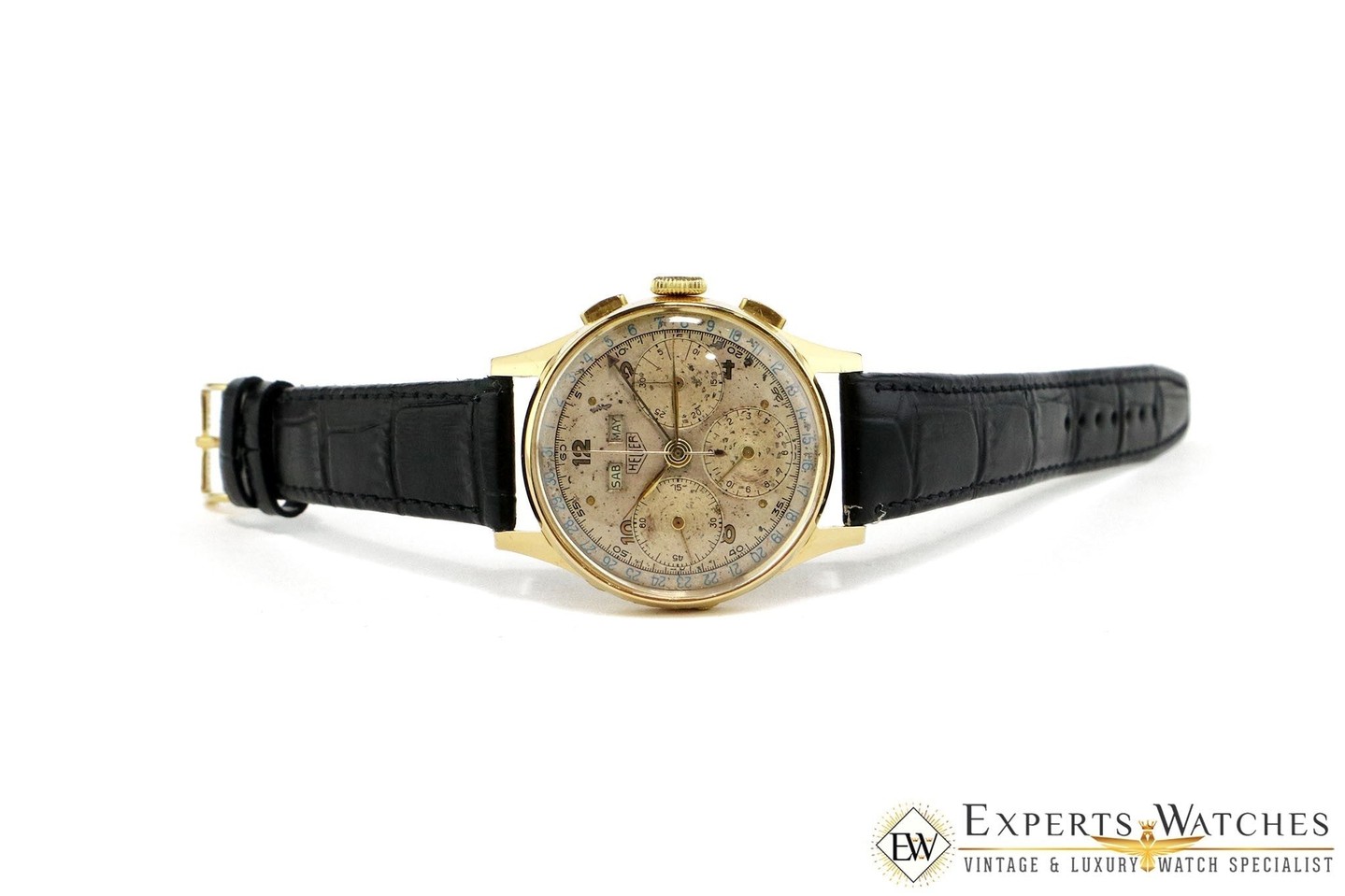
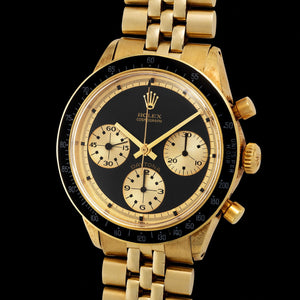
In 1969 came the cal. 727, which saw an increased beat rate from 2.5Hz to 3Hz — a modification involving the replacement of approximately 15 components. Beyond these structural modifications, the Valjoux 72 also accommodated calendar complications, acquiring a full calendar in 1946 in the 72C used by Doxa, Zodiac, Gallet, and Girard-Perregaux, culminating in the legendary Rolex "Jean-Claude Killy" triple-calendar chronograph.

The Valjoux cal. 727 — introduced in 1969 with an increased beat rate of 3Hz, requiring replacement of ~15 components. (Image: Phillips)

The Rolex "Jean-Claude Killy" triple-calendar chronograph — powered by the Valjoux 72C. (Image: Phillips)
At its core, the Valjoux 72 and its equivalents represented an age of two-dimensional chronographs designed with sturdy, flat levers and springs operating on a single plane. In contrast to modern chronographs with narrow, high, and complex bridges and levers, the entire mechanism of the Valjoux 72 is clear and visible at a glance — making it easily adjustable and serviceable, though parts are increasingly scarce today.
⚙️ Lemania 2310/CH 27, 1942–1968

The Lemania 27 CHRO C12 — the movement that shares its DNA with the Omega cal. 321 that went to the Moon. Browse our Lemania collection.
Often pitted against the Valjoux 72 is the Lemania 2310 or CH 27, developed in 1942 as the "27 CHRO C12". This movement shares the same basic engineering as the Omega cal. 321 used in the Speedmaster that went to the Moon, the cal. CH 27-70 Q in the Patek Philippe ref. 3970, and the later ref. 5070. The "27 CHRO C12" was a 27mm (12-ligne) column-wheel controlled chronograph with a 12-hour counter — a specification that placed it in direct competition with the Valjoux 72 for the most prestigious watch commissions of the era.
The famed cal. 321 differed from the original 27 CHRO C12 primarily in terms of the jumper spring for the minutes. The original movement features a robust, single-piece blade-type spring, while the cal. 321 was modified to have a complex wire spring and click — a feature interestingly absent in the Patek CH 27-70 Q as well as the Vacheron Constantin cal. 1142 found in the Cornes de Vache today. Both of these watches adopted the simpler, single-piece jumper, which perhaps represents a more robust and reliable solution for long-term use.
Like the Valjoux 72, the CH 27 had 17 jewels and a frequency of 2.5Hz. The modifications and improvements between derivatives of the CH 27 are endlessly fascinating, with the most impressive version being the Patek CH 27-70 Q. Apart from its obviously superior finishing, it features a fully supported chronograph clutch that pivots over the drive wheel, the technically superior Gyromax balance wheel, and a more elaborate kidney-shaped stud holder instead of the simple triangle pinned with a screw on the side.

The Patek Philippe CH 27-70 Q — the most refined derivative of the Lemania CH 27 family, featuring the Gyromax balance and a fully supported chronograph clutch. (Image: Phillips)
Like Valjoux, Lemania eventually began creating movements that were cheaper to manufacture and mass-produce. The 2310 was eventually replaced by the cam-switching Lemania 1872 in 1968 — marking the end of the column-wheel era for the manufacturer and the beginning of a new cost-driven chapter in Swiss watchmaking.
⚙️ Venus 175/178 Family, 1940s–1960

The Breitling Top Time housing the Venus 178 caliber — one of the most extensively used chronograph movements of the 1940s–1960s. Browse our Breitling collection.
Among the trio of movement makers, Venus is tragically less famous today — it was never worn by Butch Cassidy, neither has it been to the Moon. But the 175/178 family of chronograph movements were no less impressive. They were used by scores of now-forgotten brands but most extensively by Breitling, appearing in the Top Time, Chronomat, Navitimer, Unitime, Duograph, and more.
Produced from 1942 until around 1960, the Venus 175 family had several characteristics that distinguished it from its Valjoux and Lemania counterparts. First, the movement featured a seven-pillar column wheel instead of nine. Fewer pillars ensured more robust and reliable operation — though having more pillars would mean less rotational force needed and therefore a softer pusher feel. Second, it featured a drop-hammer design. With a Valjoux, pushing the lower button to reset the chronograph requires a definite force to push the hammers down onto the heart pieces. In contrast, pressing the reset button on a Venus releases a spring-loaded hammer — cocked when the start button is first depressed — which then lands smoothly on the heart pieces, rotating the chronograph to zero with a satisfying precision.

The Venus 175 — a 17-jewel, 2.5Hz column-wheel chronograph with the distinctive seven-pillar column wheel and drop-hammer reset. (Image: Urdelar.se)
The family of calibres included the Venus 184 with date, moon phase, and hour counter, and the Venus 185, a split-seconds chronograph. All shared the same foundation: the calibre 175, a 17-jewel movement with an operating frequency of 2.5Hz. The 175 had two sub-dials while the 178 and beyond added an hour counter. In the late 1940s, as demand for cheaper chronographs grew, Venus also began producing cam-switched chronographs — the 188, 200, and 210.

The Seagull ST19 — derived from the Venus 175 after Tianjin Watch Factory purchased the rights and machinery, upgrading it from 17 to 19 jewels. Still in production today. (Image: Kamisky Blog)
Competition was stiff, and Venus sought a financial boost by selling the rights and machinery of their cal. 175 to the Tianjin Watch Factory in China, who subsequently upgraded the original 17-jewel movement to their own ST19 — a 19-jewel movement still in production today. By the mid-1960s, the popularity of chronographs slowly began to decline due to increased interest in automatic and waterproof time-only watches. Venus eventually closed its doors in 1966, and its assets were absorbed by rival Valjoux, which discontinued column-wheel production and concentrated on the Venus cam-switched cal. 188, renamed the Valjoux 7730 series.
⚙️ The Rattrapante Chronographs

The Valjoux 55 in the Rolex ref. 4113 — the only split-seconds chronograph ever produced by Rolex, and one of only 12 made. (Image: Phillips)
At the very pinnacle of chronographs is the split-seconds — or rattrapante — which allows for the measurement of two events that begin simultaneously but conclude at different times. Mechanically, it is a standard chronograph mechanism with an additional wheel for the split-seconds stacked on top of the chronograph seconds wheel. This wheel has a spring-loaded lever affixed to it that acts on the heart cam of the chronograph seconds wheel beneath.
When the split-seconds mechanism is activated, the "pincers" around the split-seconds wheel close in on it, while the chronograph seconds wheel beneath continues to rotate. Once deactivated, the pincers open and the split-seconds wheel springs back from the force of the spring-loaded lever onto the heart cam. The modular nature of the complication means a split-seconds mechanism can be removed from or added to a base chronograph movement — a fact that made it accessible to multiple manufacturers working from shared base calibres.
⚙️ Valjoux 55, Late 1940s–1950s

Rolex ref. 4113 — one of only 12 ever produced, fetching over CHF 2 million at auction. Powered by a unique three-pusher variant of the Valjoux 55. (Image: Phillips)
Considering the rarity and complexity of the split-seconds complication even by today's standards, the rattrapante chronographs of the mid-20th century were miracles in their own right. Their scarcity in modern watchmaking has no doubt bolstered appreciation and demand on the vintage market. When brand prestige and rarity combine, prices are through the roof — examples include the legendary Rolex 4113 that fetched over CHF 2 million at auction, and the Universal Genève HA-1 Rattrapante "A. Cairelli" for which prices have shot past CHF 150,000.
Both of these watches were powered by the Valjoux 55, a split-seconds version of the Valjoux 54 originally conceived for pocket watches. At 39mm (17.3 lignes) in diameter, it was one of the largest split-seconds movements of that era, making examples extremely desirable in modern times. The Rolex 4113 was the only split-seconds chronograph ever produced by Rolex — and only 12 were made. The Valjoux 55 inside it was also remarkably different from the standard version, featuring three pushers instead of two: the top for the split-seconds, the pusher co-axial to the crown for start and stop, and the bottom pusher for reset.

At 39mm (17.3 lignes) in diameter, the Valjoux 55 was one of the largest split-seconds movements of its era. The Universal Genève HA-1 Rattrapante "A. Cairelli" — prices past CHF 150,000. (Image: Phillips)

The ultra-large Valjoux 55 — at 39mm in diameter, one of the most imposing vintage chronograph movements ever produced. Browse our Valjoux collection.
⚙️ Venus 179/185/190 Family, 1940s–1950s

Breitling Duograph ref. 764 — powered by the Venus split-seconds family. One of the most collectible rattrapante chronographs of the 1940s–1950s. (Image: Phillips)
Venus' expertise in chronographs culminated in the split-seconds calibres 179, 185 (with hour counter), and 190 (with hour counter, date, and moonphase) in the 1940s and '50s. These calibres shared the same basic construction as the Venus 175 with the addition of the split-seconds mechanism on top. These movements were used most notably in the Breitling Duograph — one of the most collectible rattrapante chronographs of the era and a watch that remains significantly undervalued relative to its Swiss competitors.
The Venus rattrapante family represents the pinnacle of what the manufacturer achieved before its closure in 1966. For collectors seeking a genuine split-seconds chronograph at a more accessible price point than a Patek Philippe or Rolex rattrapante, a Breitling Duograph powered by the Venus 179 or 185 represents one of the finest values in vintage horology.
⚙️ Patek Philippe 13-130 CCR, 1938–1971

The Patek Philippe ref. 1436 — produced from 1938 to 1971, the first serially produced split-seconds chronograph by the brand. (Image: Phillips)
One brand that led the way in rattrapante chronographs was Patek Philippe. The ref. 1436, produced from 1938 to 1971, was the first serially produced split-seconds chronograph by the brand. The movement inside was the 13-130 CCR, based on the 13-ligne movement used in the ref. 130 chronograph — itself a heavily modified Valjoux 23.
Because it utilises the framework of the 12-ligne Valjoux 23, the movement is magnificently compact. Notable modifications include a fully supported chronograph clutch that pivots over the upper fourth wheel, a cap over the column wheel hub, and the implementation of a swan neck regulator — a hallmark of Patek Philippe's finishing philosophy.

The split-seconds cal. 13-130 CCR — Patek Philippe's magnificently compact rattrapante movement based on the Valjoux 23 architecture. (Image: Phillips)
The ultimate rattrapante from this era, however, is the ref. 2571 — a split-seconds chronograph and perpetual calendar, the father of the modern-day ref. 5004. Produced in just three pieces in 1955, it is by far the holy grail of split-seconds chronographs and one of the most important watches ever made.
⚙️ The Flyback Chronographs
Some of the most remarkable chronograph movements of the 20th century — with the exception of split-seconds chronographs — came from Longines. In 1935, the firm filed a patent for the flyback mechanism, giving rise to the legendary 13ZN in 1936 and its successor, the 30CH in 1947. These movements replaced the Longines 13.33ZN, the first chronograph movement that was not derived from a pocket watch calibre — itself a landmark achievement in the history of wristwatch horology.
Most notably, the 13.33ZN featured an instantaneous jumping minutes recorder — a complex feature found in pocket watch movements that remains exceptionally rare today, with two modern examples being the A. Lange & Söhne Datograph and the Patek Philippe 5170. In a standard wristwatch chronograph, a finger mounted on the chronograph seconds wheel advances the minutes counter every 60 seconds, causing the minute hand to creep forward slowly before jumping to the next marker. In contrast, a snail-cam-and-lever system in an instantaneous-jumping mechanism ensures a clean, precise jump every 60 seconds — a feature of extraordinary mechanical refinement. This system eventually gave way to the more cost-effective semi-instantaneous mechanism in the 13ZN and 30CH.
⚙️ Longines 13ZN, 1936

The legendary Longines 13ZN — introduced in 1936 with 17 jewels, a diameter of 29.8mm, and a Breguet hairspring. One of the most historically significant flyback chronograph movements ever made.
Introduced in 1936, the flyback 13ZN had 17 jewels, a diameter of 29.8mm (13.2 lignes), and a height of 6.05mm. It operated at a frequency of 2.5Hz and was equipped with a Breguet hairspring. For a long time, the 13ZN was believed to be the first chronograph equipped with a flyback function — hence its extraordinary desirability among collectors. However, it was recently discovered that the flyback function was already incorporated in certain 13.33ZN examples, which would make the combination of instantaneous minutes plus flyback function in specific 13.33ZN references the most technically desirable of all Longines chronograph movements.
One notable variation of the 13ZN is the 13ZN-12 — essentially the 13ZN reworked to feature a central minute counter. It is believed that only 500 examples were produced, making it the rarest variation among the three Longines chronograph movements produced before the discovery of the flyback 13.33ZN. A Longines chronograph powered by the 13ZN-12 with central minutes sold for CHF 87,500 at Phillips in 2016.

A Longines chronograph powered by the 13ZN-12 with central minutes — sold for CHF 87,500 at Phillips in 2016. Only ~500 examples produced. (Image: Phillips)
⚙️ Longines 30CH, 1947

The Longines 30CH — successor to the 13ZN, notable for its inverted movement layout with the balance wheel at 12 o’clock rather than the conventional 6 o’clock position.
The 13ZN was eventually succeeded by the 30CH in 1947. The movement specifications of the 30CH are nearly identical to the 13ZN, with one striking exception: the layout of the movement is inverted. While the balance wheel in most chronographs is positioned at six o’clock when viewed from the case back, the balance in the 30CH is located at 12 o’clock. This is a minor oddity that required a wholesale redesigning of the movement — including bridges, wheels, and levers — for what amounts to a cosmetic difference in the finished watch.
The clutch wheel encroaches over the balance wheel while the switching works are also inverted. Apart from a slightly different pusher feel — because the lever to the column wheel is shorter in the 30CH — this layout is virtually inconsequential in use. It does, however, pique curiosity as to why Longines would undertake such a significant redesign. The 30CH was the last in-house chronograph produced by Longines, as demand for low-cost chronographs continued to grow and the economics of in-house production became increasingly difficult to justify.
⚙️ The Clinergic 21 & the Race for the First Automatic Chronograph

A print advertisement for the Clinergic 21 escapement from 1969 — the technological breakthrough that enabled the first automatic chronographs to operate at 4Hz and 5Hz.
By the mid-1960s, there was a pressing need to break out from the conventional operating frequency of 2.5Hz as the threat of quartz resonators loomed large. Fabriques d’Assortiments Réunis (now Nivarox) began developing an improved Swiss lever escapement with 21 teeth instead of 15, known as the Clinergic 21. This allowed movements to operate at 4Hz or 5Hz — a dramatic improvement over the 2.5Hz and 3Hz standard of the era. The escapement made its debut in 1966 and became the enabling technology behind the 1969 automatic chronograph revolution.
It is worth noting that the seeds of automatic chronograph innovation were planted by Lemania as early as the 1940s. Five years after the launch of the CH27, the compact chronograph became the testbed for a “bumper” rotor developed as the CH27 C12 A. The project was ultimately abandoned as superfluous — but the concept would prove prescient two decades later.
The introduction of the first automatic chronograph was a three-way contest between Seiko, a consortium made up of Dubois-Dépraz, Büren, Breitling, and Heuer, and lastly Zenith — who in 1960 had acquired chronograph specialist Martel. The question of who came first is historically murky, but what is perhaps more interesting is the unique set of engineering challenges and solutions each movement represented.
⚙️ Seiko 6139 Speed-Timer, 1969–1979

The Seiko 6139 Speed-Timer — the first automatic chronograph to incorporate a vertical clutch, a technical achievement that Rolex would not match for another two decades. Browse our chronograph collection.
The Seiko 6139 Speed-Timer was the first automatic chronograph to incorporate a vertical clutch — an advanced coupling system superior to the horizontal clutch systems of the time in both durability and functionality. A vertical clutch reduces amplitude loss and eliminates the initial stuttering of the seconds hand when the chronograph is engaged — a problem that plagued horizontal clutch designs. To put this accomplishment into perspective: it would take Rolex two more decades to update the Daytona with an automatic movement, and it would have to rely on the El Primero (with a horizontal clutch) to do so. It would then take the brand another decade to launch its own automatic movement with a vertical clutch.
Impressively compact, the Seiko 6139 had a diameter of 27.4mm (12.1 lignes) and a height of 6.5mm. It operated at a frequency of 3Hz and featured a ball-borne full rotor working in conjunction with Seiko’s signature Magic Lever — a compact and efficient bidirectional winding system with a Y-shaped lever and pawl that remains one of the most elegant winding solutions in watchmaking history. The movement went out of production in 1979, which explains why it remains relatively unknown compared to the other two 1969 chronographs that have enjoyed a strong collector following to this day.
⚙️ “Project 99” Chronomatic / Caliber 11, 1969–1970s

The Chronomatic Caliber 11 without the chronograph module — the Dubois-Dépraz module 8510 mounted on the ultra-thin Büren Intramatic base. Used in early Heuer and Breitling automatic chronographs.
The Chronomatic Caliber 11 was unveiled by the consortium of Dubois-Dépraz, Büren, Breitling, and Heuer. It was composed of a lever-and-cam operated Dubois-Dépraz chronograph module 8510 mounted on top of an ultra-thin Büren Intramatic movement. The Chronomatic was the only modular chronograph of the three 1969 contenders — yet the Intramatic base was itself a remarkable achievement, enabling the entire movement to be surprisingly slim despite its stacked construction. It measured just 7.7mm high and 31mm (13.75 lignes) wide, with a frequency of 2.75Hz and a power reserve of 42 hours.
The modular approach had a significant commercial advantage: the Dubois-Dépraz module could be fitted to different base movements, making it adaptable across multiple brands and price points. The Caliber 11 appeared in the Heuer Carrera, Monaco, and Autavia — three of the most collectible vintage chronographs ever made — as well as in early Breitling automatic chronographs. The crown-at-left configuration of the Monaco, necessitated by the modular layout, became one of the most iconic design signatures in watch history.
⚙️ Zenith El Primero, 1969 – Present

The 1969 Zenith El Primero 3019 calibre with the rotor removed — the only automatic chronograph of 1969 beating at 5Hz, enabling 1/10th second accuracy. Still in production today.
Zenith introduced the El Primero — the only automatic chronograph of the three 1969 contenders with a beat rate of 5Hz, enabling it to measure time with an accuracy of 1/10th of a second thanks to the incorporation of the Clinergic 21 escapement. It was a fully integrated chronograph with a column wheel and horizontal clutch — the most mechanically pure configuration of the three.
Most remarkably, the El Primero had a power reserve of 50 hours — which, alongside its high balance amplitude, signified an exceptionally well-designed movement demonstrating optimal use of space. Conventionally, a lengthened power reserve is achieved at the expense of balance amplitude. The El Primero achieved both simultaneously. The Valjoux 7750 — the legendary workhorse of the post-Quartz era — strikes a viable balance with a frequency of 4Hz and a power reserve of 44 hours. But the El Primero surpasses it on both counts, and manages to be slimmer at 6.5mm versus the 7750’s 7.9mm.
The El Primero’s historical significance was cemented when Rolex chose it — modified to run at 4Hz — to power the Daytona from 1988 to 2000, while developing its own in-house automatic chronograph caliber. It remains in production today, making it the longest-running automatic chronograph movement in history.
⚙️ The Second Wave of Automatics
After the launch of the three pioneering automatic chronographs in 1969, a second wave of automatic movements followed just as quartz technology was gaining momentum on the horizon. These movements — from Seiko, Citizen, Lemania, and Valjoux — were shaped by the economic and technical pressures of the Quartz Crisis, resulting in a distinctly different engineering philosophy: doing the most with the simplest and fewest components.
⚙️ Seiko 7017, 1970 – Late 1970s

Seiko 5 Sports Speed Timer “Flyback” with the cal. 7017 — a column-wheel, vertical-clutch flyback chronograph introduced just one year after the 6139. (Image: hubcityvintage.com)
Seiko doubled down on its landmark innovation with the introduction of yet another automatic chronograph just one year later — the cal. 7017, a flyback chronograph with a column wheel and vertical clutch. The movement did away with the elapsed minute counter and, like the pioneering 6139, lacked an active running seconds display. At its core it was a three-hand watch with a zero-reset function — a minimalist approach that was entirely deliberate.
A vertically coupled chronograph is particularly well-suited to this design. Vertical clutches are of a co-axial structure that generates friction when the chronograph is not in use, as the fourth wheel rotates independently. By keeping the chronograph seconds running as the actual running seconds display, wear is minimized. As a result of its minimalist construction, the cal. 7017 stood just 6.4mm high — significantly slimmer than the 7.9mm of the 6139 just a year before. The cal. 7017 later acquired a 30-minute counter in the 7018 and a combined minute and hour counter in the cal. 7016. The family operated at 3Hz with a power reserve of approximately 40 hours and cannot be hand-wound.

Seiko automatic flyback chronograph equipped with the cal. 7016 — featuring integrated hour and minute chronograph counters. Browse our vintage chronograph collection.
⚙️ Citizen 8100A/8110A, 1972 – Early 1980s

Citizen automatic flyback chronograph with the cal. 8100 — at 5.82mm, the slimmest automatic chronograph of its era. (Image: Mitka.co.uk)
Right on the heels of Seiko came another Japanese watchmaker: Citizen. Introduced in 1972, the caliber 8100A and 8110A represented an advanced class of ultra-thin flyback chronographs running at a higher frequency of 4Hz and capable of being hand-wound — an advantage over the Seiko 7017 family. The 8100A had a 30-minute counter, while the 8110A added a 12-hour totaliser. The 8110A stood at 6.9mm high while the 8100A measured just 5.82mm — making it the slimmest automatic chronograph of its era, a record it held until the introduction of the Frédéric Piguet 1158.
⚙️ Lemania 1340, 1972–1975

The Omega Speedmaster 125 powered by the chronometer-grade cal. 1041 — the world’s first automatic chronograph chronometer, based on the Lemania 1340. Browse our Omega collection.
In 1972, Lemania developed the cal. 1340, which would be adopted by Omega as the 1040/1041. It was a horizontally coupled, cam-switched automatic chronograph with an eccentric layout redolent of the experimental spirit of the decade. It featured centrally-mounted hands for both the chronograph seconds and minutes — making elapsed time reading intuitive while freeing up dial space for other indications. A 12-hour totaliser sat at six o’clock, a small seconds counter doubling as a day/night indicator at nine o’clock, and a date window at three. Its peculiar design permeated every aspect of the watches it inhabited — most notably the Omega Speedmaster 125, with its equally distinctive tonneau case and integrated bracelet.
The movement ran at 4Hz and offered a 44-hour power reserve. The key difference between the Lemania 1340 and the Omega 1040 was the addition of a 24-hour indicator in the small seconds at nine o’clock. The Omega 1040 was Omega’s first automatic chronograph movement, while the 1041 was the world’s first COSC-certified chronograph — a landmark achievement in precision timekeeping.
⚙️ Lemania 5100, 1974 – Early 2000s

The Sinn 157 St Ty equipped with the Lemania 5100 — one of the most robust military-grade automatic chronograph movements ever produced. Browse our Lemania collection.
The Lemania 1340 was eventually replaced by the legendary 5100 in 1974. The dial layouts of both movements are almost identical — except the 5100 added a separate 24-hour counter at 12 o’clock. Mechanically, however, they were worlds apart. The 5100 was designed in the thick of the Quartz Crisis, which heralded a perceived need for cost-efficient yet better-performing mechanical movements — and it delivered on both counts in unconventional ways.
First, it featured a vertical clutch system that made it sufficiently robust for military applications. In contrast to a horizontally coupled chronograph in which the seconds is driven by an intermediate wheel, the 5100’s vertical clutch is integrated with the fourth wheel, directly driving the chronograph seconds. This gave the 5100 excellent shock resistance — the seconds hand was far less prone to stopping under impact than in horizontally coupled movements of the time.

The Lemania 5100 with its cost-effective pillar-type construction — the vertical clutch next to the escape wheel is integrated with the fourth wheel and drives the chronograph seconds wheel directly. (Image: watchguy.co.uk)
More unusual was its anachronistic architecture. The movement plate and bridges were held together by pillars, sandwiching the moving parts — significantly reducing construction costs as parts could be stamped rather than milled. Components including the column wheel, clutch plate, and calendar wheel were made of Delrin, a high-tech self-lubricating plastic. The rotor was seated on a hard iron bearing held in place with a push fork rather than the ball-borne rotor of the 1340. In contrast to its utilitarian construction, its specifications were decidedly advanced: 4Hz frequency and a 48-hour power reserve.
⚙️ Valjoux 7750, 1974 – Present

The Valjoux 7750 with its layered switching cam and oscillating pinion — the most widely used automatic chronograph movement in history, still in production today. Browse our Valjoux collection.
Meanwhile, Valjoux’s response to the pioneering automatics was the cal. 7750 — a landmark workhorse that would prove indispensable to watchmaking for the next half-century. Like the Lemania 5100, the 7750 was designed with the implications of the Quartz Crisis in mind, reflecting a philosophy of doing the most with the simplest and fewest components.
Crucially, the Valjoux 7750 was among the first movements built with computer-aided design (CAD) technology, allowing various aspects of the transmission system to be optimized for performance. It features a notably high-torque mainspring that famously allows it to accommodate complications ranging from perpetual calendars to tourbillons with no impact on chronometry. Its gear train has been continuously adopted by many brands in both chronograph and non-chronograph movements due to its robustness and reliability.
Like the Lemania 5100, the Valjoux 7750 uses a switching cam — which, unlike a column wheel, can be stamped and produced in volume. Where it differed from its contemporaries was its coupling system: the oscillating pinion — an arbour with a pinion on both ends — is the simplest, most practical way to connect the fourth wheel on the base plate to the chronograph seconds above. While the oscillating pinion had been used previously in movements such as the Venus 170 and the Valjoux 92, it was the 7750 that brought it to the forefront of modern chronograph design. After the Quartz Crisis, Valjoux consolidated into ETA, which became part of Swatch Group, and the 7750 became the industry’s default automatic chronograph for decades.
⚙️ Frédéric Piguet 1185, 1988 – Present

The Frédéric Piguet 1185 — at 26mm diameter and 5.5mm high, the smallest and slimmest automatic column-wheel chronograph of its era. Fourth wheel visible under the bridge at 12 o’clock.
In the years that followed the Quartz Crisis, chronographs became sharp reflections of the seismic changes in Swiss watchmaking. In 1988, Frédéric Piguet unveiled the cal. 1185 — an automatic movement replete with upscale features: a column-wheel and vertical-clutch design (the most technically superior and costly configuration), a ball-bearing rotor, a micrometer regulator, and a Kif shock absorber. The movement would prove greater than the sum of its parts.
For a long time, the cal. 1185 stood as the smallest and slimmest automatic column-wheel chronograph in existence — measuring just 26mm in diameter and 5.5mm high, based on the hand-wound ultra-thin cal. 1180 introduced a year earlier. Its gear train layout is typical of a time-only watch with a small seconds, with the fourth wheel located at six o’clock. The escape wheel pinion drives the chronograph seconds wheel in the middle — a construction that allows the movement to be exceptionally compact. The ball-borne rotor accounts for a mere 1.55mm in height. It runs at 3Hz and offers a power reserve of 42 hours.
A year after its introduction, the caliber spawned the world’s first automatic rattrapante — the 1186 — standing at just 6.9mm high. After Frédéric Piguet was integrated into Blancpain, the 1185 continued to find success both within and outside of Swatch Group, most notably in the Audemars Piguet Royal Oak Chronograph.
❓ Frequently Asked Questions
What makes the Valjoux 72 so important in watchmaking history?
The Valjoux 72 established the definitive layout of the modern chronograph — a 12-hour counter at six o'clock, horizontal clutch, and column wheel — that virtually every subsequent chronograph has referenced. Its use in the Rolex Daytona, Patek Philippe Calibre 12, and Heuer Carrera makes it the most historically significant vintage chronograph movement ever produced.
What is the difference between the Valjoux 72 and the Lemania CH 27?
Both are 17-jewel, 2.5Hz column-wheel chronographs with 12-hour counters, but they differ in architecture and feel. The Valjoux 72 is 13 lignes and uses a conventional reset hammer, while the Lemania CH 27 is 12 lignes and uses a different jumper spring design. The CH 27 is also the direct ancestor of the Omega cal. 321 — the movement that went to the Moon — giving it an unmatched historical provenance.
Why is the Venus 175 less famous than the Valjoux 72 or Lemania CH 27?
Primarily because Venus closed in 1966 and its movements were never used in a watch with the cultural profile of the Rolex Daytona or Omega Speedmaster. However, the Venus 175 family is technically equal to its competitors and its use in early Breitling Navitimers and Chronomats makes it highly collectible. It represents exceptional value for collectors who know what to look for.
What is a rattrapante or split-seconds chronograph?
A rattrapante (French for "catch up") or split-seconds chronograph has two seconds hands — one that runs continuously and one that can be stopped independently to record an intermediate time, then "caught up" to rejoin the running hand. It allows the timing of two events that start simultaneously but end at different times — making it invaluable for sports timing and one of the most complex complications in watchmaking.
How many Rolex ref. 4113 watches were made?
Only 12 examples of the Rolex ref. 4113 were produced — making it the rarest split-seconds chronograph ever made by the brand, and one of the rarest Rolex references in existence. It was powered by a unique three-pusher variant of the Valjoux 55 and sold at Phillips auction for over CHF 2 million.
What is the Patek Philippe ref. 1436 and why is it significant?
The ref. 1436 was the first serially produced split-seconds chronograph by Patek Philippe, produced from 1938 to 1971. It is powered by the 13-130 CCR movement — a heavily modified Valjoux 23 with Patek's signature swan neck regulator and fully supported chronograph clutch. Its 33-year production run makes it one of the most important rattrapante references ever made.
Are vintage chronographs from this era still serviceable today?
Yes — the Valjoux 72, Lemania CH 27, and Venus 175 family are all still serviceable by experienced watchmakers, though parts availability varies. At Experts Watches, our in-house watchmakers specialize in vintage Swiss chronograph movements. Contact us to discuss service for your vintage chronograph.
Where can I buy an authenticated vintage chronograph from this era?
Every vintage chronograph at Experts Watches goes through our Certified Pre-Owned Program — inspected, timed, and authenticated in-house by our team. Browse our Valjoux, Lemania, and Venus collections, or contact us for personalized guidance.
What was the first automatic chronograph ever made?
The first automatic chronograph is a contested title between three movements launched in 1969: the Seiko 6139 Speed-Timer, the Chronomatic Caliber 11 (by Heuer, Breitling, Büren, and Dubois-Dépraz), and the Zenith El Primero. The Seiko 6139 was technically first and uniquely featured a vertical clutch. The El Primero is the only one still in production today.
What is a flyback chronograph?
A flyback chronograph allows the user to reset and restart the chronograph with a single press of a button, rather than the three-step stop-reset-start sequence of a standard chronograph. The Longines 13ZN (1936) was among the first wristwatch movements to incorporate this function.
Why is the Zenith El Primero significant?
The El Primero is the only automatic chronograph from the 1969 race still in continuous production. It beats at 5Hz — enabling 1/10th second accuracy — and was chosen by Rolex to power the Daytona from 1988 to 2000. Its combination of column wheel, high frequency, and 50-hour power reserve made it the benchmark automatic chronograph of the 20th century.
What is the Valjoux 7750 and why is it so widely used?
The Valjoux 7750 is the most widely used automatic chronograph movement in history, introduced in 1974 and still in production today. Designed with CAD technology during the Quartz Crisis, its high-torque mainspring, oscillating pinion coupling, and exceptional adaptability made it the default automatic chronograph for dozens of brands for over 50 years.
What makes the Lemania 5100 special?
The Lemania 5100 (1974) is built with a pillar-plate construction, Delrin plastic components, and a vertical clutch for military-grade shock resistance. Despite its cost-driven architecture, it operates at 4Hz with a 48-hour power reserve and was used extensively in British MoD military watches and by Sinn and Omega.
📚 Related Guides at Experts Watches
• Watch Complications & Functions Guide — every complication explained, from chronograph to tourbillon.
• Complete History of the Chronograph Movement — the full master article.
• Vintage Watch Care & Maintenance Guide — how to protect and service your vintage chronograph.
• Rolex Serial Number Lookup — date your Rolex by serial number.
• Certified Pre-Owned Program — every watch inspected, timed, and authenticated in-house.

Every vintage chronograph at Experts Watches is covered by our Certified Pre-Owned Program — inspected, timed, and authenticated in-house.
Watch Gallery
Connecting Collectors with Iconic Timepieces Since 2000

Our collections


Testimonials
Could Not Ask For Better Service! Shipping was unbelievably quick! Awesomeness at its finest!
Highly Recommend!! I'm over satisfied! ExpertsWatches is awesome! So legit!
Very professional! Holy Crap that was fast!👍🏽🤣👍🏽
Michael I.
JAEGER LeCOULTRE Master Compressor Titanium Diving PROGeographic GMT
Our Latest Thoughts

IWC, Porsche Design, and Titanium Watches
Read more

The Ultimate Guide To Buying Vintage Watches For Investment
Read more

Winners of the 2025 GPHG Watch Awards
Read more